Facts and logistics can be a form of care.
Sometimes the honest conversation is simply about what happened, what is needed, or when to meet. Staying with the practical is not avoidance when the practical is what the moment asks for.
Practice path
Being real while staying connected, with care for self, other, and context.
Why this page exists
This page is a home for reflections and practices around honest relationship.
For much of my life, I thought being kind meant keeping things smooth. I often tried to manage the emotional atmosphere around me so I could feel safe, accepted, or loved. I did not always experience this as control. Often, it felt like care.
Authentic relating is helping me notice the difference.
To me, this work is not about saying everything bluntly, exposing private stories, or demanding that other people meet me exactly where I am. It is the practice of noticing what is happening inside me, owning it, expressing it cleanly, and making room for the other person's reality too.
What authentic relating means here
I am learning to tell the truth without using truth as a weapon, and to stay connected without managing another person's experience.
Working framework
At the center of this map are presence, curiosity, compassion, and courage. Around them are four simple movements: slow down, be present, speak truth with care, and stay connected to our shared humanity. A map can orient us without becoming another standard we must perform perfectly.
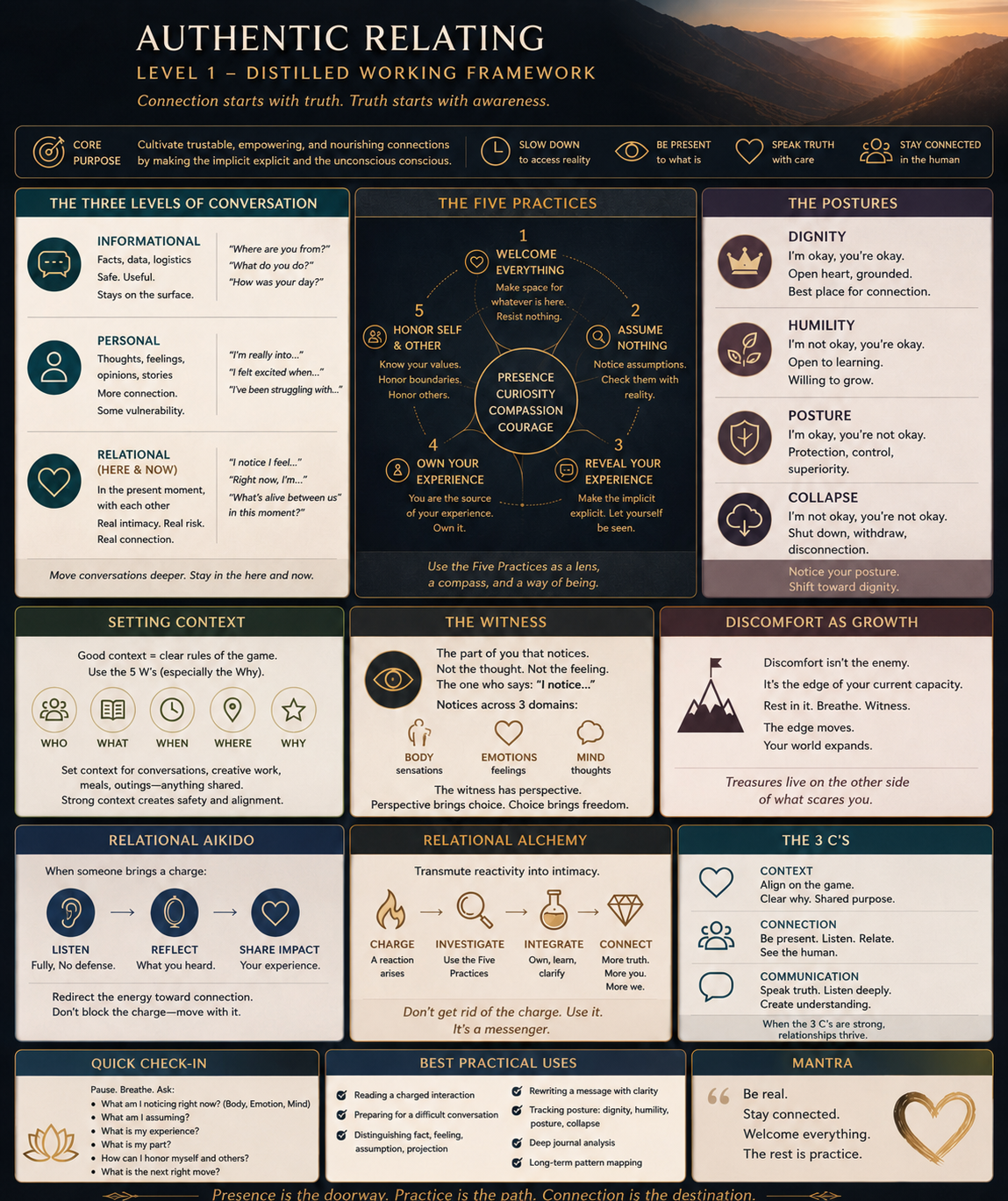
Authentic Relating — Level 1: Distilled Working Framework. This mark-free AI-generated edition was created by ChatGPT at the request of KarmaAndGrace.life's owner and is included here with the owner's approval. It intentionally contains no ART International logo or mark. ART International did not create this graphic, and this page does not claim ART approval or endorsement of it. The graphic combines the Five Practices and Three Levels described in the linked ART International materials with additional independent synthesis; it is not official ART International curriculum. KarmaAndGrace.life independently recommends ART International's official training below.
ART International sources for the Five Practices and Three Levels: ART International (Authentic Relating Training) at authenticrelating.co, The Five Practices of Authentic Relating, and The Three Levels of Conversation.
Three levels of conversation
The framework distinguishes informational, personal, and here-and-now relational conversation. These are useful modes, not a ladder of human worth. Deeper is not automatically better; the right depth is the one the moment, relationship, and people involved can actually hold.
Sometimes the honest conversation is simply about what happened, what is needed, or when to meet. Staying with the practical is not avoidance when the practical is what the moment asks for.
Thoughts, feelings, opinions, and stories reveal more of a person. Vulnerability becomes relational when it respects consent and does not make the listener responsible for carrying it.
“I notice I feel farther away as we talk” can create real contact. It also carries more risk, so timing, trust, power, and the other person's capacity matter as much as courage.
The five practices
These practices work best as a lens rather than a script. Each one protects the others: welcome without discernment can become passivity, revelation without ownership can become blame, and honoring another without honoring oneself can become disappearance.
Let an experience enter awareness before trying to improve, explain, or reject it. Welcome does not mean approving harmful behavior or surrendering a boundary.
Separate observation from interpretation, then check the interpretation with reality. “Assume nothing” is an invitation to curiosity, not a demand to ignore pattern or instinct.
Let yourself be seen without turning disclosure into pressure, proof, or a demand for a certain response. Authenticity includes choosing what not to share and when not to share it.
Name sensations, feelings, wants, limits, and interpretations as yours. Ownership makes responsibility clearer; it does not erase another person's choices or impact.
Stay connected to your own experience while respecting that another person may experience the same moment differently. A clear no, a pause, or more distance may be the most dignifying response available.
Listen for what landed, reflect what you heard, share your own impact, and take responsibility where you can. Repair is not self-punishment, forced agreement, or an instant return to closeness.
“I notice my chest tightening. I am telling myself you are pulling away, and I know that is an interpretation. Would you be willing to tell me how this moment is for you?”
Witness, context, and the three C's
Witnessing creates a little room between experience and action. It is not detachment from feeling. If inward attention brings panic, dissociation, or overwhelm, orienting to the room, the body, a trusted person, or qualified support may be wiser than pressing further.
Who is involved? What are we doing? When and where? Most of all, why are we having this conversation? Clear context reduces hidden expectations and gives everyone a better chance to choose.
Clear language helps, but communication alone cannot repair a missing agreement, a power imbalance, or a lack of safety. First align on the purpose, then meet the person, then choose the words.
Relational postures
The framework uses “I'm okay / you're okay” language to describe four orientations. Read compassionately, these are temporary ways of organizing a moment, not diagnoses, verdicts, or measures of human worth. The movement is toward dignity, not shame about where we began.
Both people retain worth, agency, and reality. This grounded posture makes room for warmth, difference, accountability, and a connection that is not built on winning.
Humility can open growth when certainty softens. It should not require self-erasure or making the other person superior; equal dignity remains underneath the willingness to be changed.
Control or superiority can protect something tender, threatened, or afraid. Seeing the protection may help us own it, but understanding a defense does not excuse the harm it can cause.
Shutdown, withdrawal, or hopelessness may signal that capacity is gone. The next honest move may be rest, support, distance, or a much smaller conversation—not forcing connection from an empty place.
Charge and discomfort
Listening without immediate defense does not require agreement, silence about a false claim, or surrendering a boundary. Reflection can sound like “What I hear is…”; impact can sound like “What happens in me as I hear that is…”
Charge may point toward fear, longing, memory, injustice, or a crossed limit. Investigate it before turning it into proof about yourself, the other person, or what must happen next.
Some discomfort is the edge of learning; some is information about danger, coercion, power, or insufficient capacity. Pausing, leaving, seeking support, or saying “not now” can be deeply authentic acts.
A consent-aware check-in
These questions are not a ritual to perform perfectly. They are a way to slow reactivity and make room for reality, agency, and care.
What this is not
Recommended next step · schedule checked July 22, 2026
KarmaAndGrace.life endorses ART International's official Level 1 and Level 2 courses as a thoughtful next step for readers who want facilitated, experiential practice rather than ideas alone. This is an independent editorial recommendation; it does not claim that ART International sponsored, reviewed, or approved this page or the AI-generated graphic.
Before you choose a course: ART-hosted course links below may add the selected offering to an ART cart. The Yoga Barn course opens external registration through Megatix. Registration and payment take place on ART International or the named venue's service, never on KarmaAndGrace.life.
ART describes Level 1 as its flagship introductory course. The online format meets for six sessions over six weeks; in-person courses are generally two full days. Level 1 must be completed before Level 2 begins.
ART describes Level 2 as advanced work with relational patterns, nervous-system awareness, somatic tools, multiple perspectives, shadow, repair, and relational design. The official prerequisite is completed Level 1 training.
Schedule status and course-year labels were checked against ART International's official course listings on July 22, 2026. Each course link follows the registration route published by ART International and may place that selection in an ART cart; the Yoga Barn offering opens the venue's external registration site. Registration and payment occur on ART International or the named external venue, not on KarmaAndGrace.life. Dates, leaders, locations, prices, and availability can change; verify the live listing before registering.
Reflections in this area
A related inquiry into people-pleasing, clean expression, repair, boundaries, and the difference between care and control.
Open relational honestyFuture essays can live here when they are grounded enough to be useful and private enough to protect the people involved.
Privacy and dignity
The patterns I write about are mine to examine. The private lives of people I love are not mine to expose. When relational material appears here, identifying details may be changed, compressed, generalized, or omitted. The aim is not to tell on other people. The aim is to tell the truth about what I am learning in myself.